Date: Aug. 22, 2012
Tonight marks my first foray into harvesting the yeast cake from my fermentor. I'll be harvesting Wyeast 1187 Ringwood Ale.
I'm basing the process off of a few videos I've seen on YouTube. This one was the most straight-forward:
Using two large mason jars: One for cleaning the yeast, and one for storage.
Wednesday, August 22, 2012

Indian Brown Ale [Secondary]
Racking date: Aug. 22, 2012
Racked the Indian Brown Ale into my new 3 gal carboy to further condition. Also able to get a read on the final gravity, flavor, smell, etc.
Observations:
FG: 1.019 (1.018 at 75 'F)
Taste: Nicely sweet and malty, bitterness prominent, alcohol-ish on the end. Tastes like the offspring of a sweet nut brown and bitter IPA. Excellent. Strong too.
Smell: Nuttiness
Color: Medium brown, not cloudy
Racked the Indian Brown Ale into my new 3 gal carboy to further condition. Also able to get a read on the final gravity, flavor, smell, etc.
Observations:
FG: 1.019 (1.018 at 75 'F)
Taste: Nicely sweet and malty, bitterness prominent, alcohol-ish on the end. Tastes like the offspring of a sweet nut brown and bitter IPA. Excellent. Strong too.
Smell: Nuttiness
Color: Medium brown, not cloudy
TBD Indian Brown Ale
Brew Date: Aug. 10, 2012
 #8
#8
3 gal
Much has happened since my last batch. But in the interest of keeping this posting short, suffice it to say that it's been a VERY long, HOT summer. With temps hitting 95+ F in the house at 8 pm throughout most of June and July, brewing anything was totally out of the question. This, of course, made me sad. And itching to brew. No longer! Here, at last, is the latest batch. The recipe is from "Extreme Brewing" by Sam Calagione, p. 142.
I recently purchased a copy of Beer Tools Pro, a software program for homebrewing. It worked great for loading all the ingredients and then scaling down the recipe.
 Ingredients:
 #8
#83 gal
Much has happened since my last batch. But in the interest of keeping this posting short, suffice it to say that it's been a VERY long, HOT summer. With temps hitting 95+ F in the house at 8 pm throughout most of June and July, brewing anything was totally out of the question. This, of course, made me sad. And itching to brew. No longer! Here, at last, is the latest batch. The recipe is from "Extreme Brewing" by Sam Calagione, p. 142.
I recently purchased a copy of Beer Tools Pro, a software program for homebrewing. It worked great for loading all the ingredients and then scaling down the recipe.
 Ingredients:
- 6-8 oz Amber Malt (Fawcett)
- 6-8 oz Caramel Malt 60L (Briess)
- 5-6 oz Chocolate Malt (Briess)
- 1-2 oz Roasted Barley (Briess)
- 1.92 kg Light DME (Golden Light) (Briess)
- 138 g Dark Brown Sugar
- 0.5 oz Warrior pellets (A: 16%)
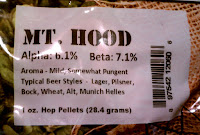
- 0.6 oz Mt. Hood hop pellets (A: 6.1%)
- Wyeast 1187 Ringwood Ale*
*Yeast starter the night before. Boil 2 c water. Remove from heat. Add ½ c (109 g) light DME. Boil 10 min. Cool and pitch yeast. Aerate on and off for approx 1 hr.
Instructions:
 In a grain bag, add amber, caramel, and chocolate malts, and roasted barley to 2 gal water heated to 150-160 F. Steep for 30 min. Remove grain bag and bring water to boil. Remove from heat and add DME. Return to boil. After 15 min, add the Warrior hops in a nylon bag and boil 60 min. 30 min before end of boil, in a separate pot, boil 1 gal water for 10 min and add to brew kettle to compensate for evaporation loss. 10 min before end of boil, add dark brown sugar. Add Mt. Hood hops at end of boil. Cover, remove from heat, and let sit for 20 min. Cool wort to 70 F. Rack to fermentor. Add cold water and top off to 3 gal. Transfer to secondary fermentor after 7-10 days to condition. Condition 2-3 weeks.
Observations:
OG: 1.072 (1.070 at 78 'F)
Smell: Roasted, slight hint of chocolate
Taste: Thick, sweet, rich, chocolate, balanced bitterness, brown sugar?
Color: Deep brown
Original recipe called for OG 1.070. Pretty darn close! Looking for a FG of around 1.015 and ABV of 7.2%. 50 IBUs.
Experience:
With Taj Mahal's "The Natch'l Blues" spinning in the background, a half day at work, and my first brew day in over two months, I was feeling fine. Not to mention a buddy of mine had managed to land me a ticket to the Great Taste of the Midwest beerfest that afternoon. All in all, I'd call it a mighty fine day. Cheers!



Instructions:
 In a grain bag, add amber, caramel, and chocolate malts, and roasted barley to 2 gal water heated to 150-160 F. Steep for 30 min. Remove grain bag and bring water to boil. Remove from heat and add DME. Return to boil. After 15 min, add the Warrior hops in a nylon bag and boil 60 min. 30 min before end of boil, in a separate pot, boil 1 gal water for 10 min and add to brew kettle to compensate for evaporation loss. 10 min before end of boil, add dark brown sugar. Add Mt. Hood hops at end of boil. Cover, remove from heat, and let sit for 20 min. Cool wort to 70 F. Rack to fermentor. Add cold water and top off to 3 gal. Transfer to secondary fermentor after 7-10 days to condition. Condition 2-3 weeks.
Observations:
OG: 1.072 (1.070 at 78 'F)
Smell: Roasted, slight hint of chocolate
Taste: Thick, sweet, rich, chocolate, balanced bitterness, brown sugar?
Color: Deep brown
Original recipe called for OG 1.070. Pretty darn close! Looking for a FG of around 1.015 and ABV of 7.2%. 50 IBUs.
Experience:
With Taj Mahal's "The Natch'l Blues" spinning in the background, a half day at work, and my first brew day in over two months, I was feeling fine. Not to mention a buddy of mine had managed to land me a ticket to the Great Taste of the Midwest beerfest that afternoon. All in all, I'd call it a mighty fine day. Cheers!


Sunday, July 22, 2012
“Red Baron" German Alt - Exploded Bottle, Tastes Great!
Just a brief note on the "Red Baron" German Alt. I found one exploded bottle in the basement this weekend -- totally shattered. It must have blown at least a few days ago since all the beer had already evaporated. I had to throw the (by now) moldy box away and wipe down all the bottles. With the hot weather over the past few weeks, the temperature downstairs has risen to 75-80 °F instead of the more typical 60-70 °F during the summer.
On a positive note, I pulled a few of the 16 oz EZ cap bottles and 22 oz bombers to share at our family campout. I hadn't tried any of the larger bottles, and none that have continued to condition in the basement for some time at the higher temps. The taste was MUCH improved. The Alt has taken on a more mellowed smoothness. Even the carbonation seems better. Several of the 12 oz bottles have been over-carbonated up till now. The beer was also several at just cooler than room temperature as well. Chilled in a cooler for a few hours.
I am dying to get cracking on another batch, but it's still too hot here. I simply can't justify having the stove on for an hour or two, to say nothing of the havoc the yeast would go through at the higher room temps.
I hate not having AC.
On a positive note, I pulled a few of the 16 oz EZ cap bottles and 22 oz bombers to share at our family campout. I hadn't tried any of the larger bottles, and none that have continued to condition in the basement for some time at the higher temps. The taste was MUCH improved. The Alt has taken on a more mellowed smoothness. Even the carbonation seems better. Several of the 12 oz bottles have been over-carbonated up till now. The beer was also several at just cooler than room temperature as well. Chilled in a cooler for a few hours.
I am dying to get cracking on another batch, but it's still too hot here. I simply can't justify having the stove on for an hour or two, to say nothing of the havoc the yeast would go through at the higher room temps.
I hate not having AC.
Sunday, June 10, 2012
“Green Eyed" (I)PA [Bottled]
Bottle date: June 3, 2012 (5+ weeks since brew date)
Got a helping hand from my dad for bottling. Thanks, Pops! All in all, it went smoothly enough (except for one spilled beer). Took approximately 2 hours to bottle. Conditioning the bottles in our basement at roughly 68-72 'F for at least three weeks before sharing. Decided to use Northern Brewer's priming sugar calculator this time around. My Red Baron German Alt seems over-carbonated...
Ingredients:
Got a helping hand from my dad for bottling. Thanks, Pops! All in all, it went smoothly enough (except for one spilled beer). Took approximately 2 hours to bottle. Conditioning the bottles in our basement at roughly 68-72 'F for at least three weeks before sharing. Decided to use Northern Brewer's priming sugar calculator this time around. My Red Baron German Alt seems over-carbonated...
Ingredients:
- 6 oz Light DME
- 16 oz cold water
Instructions:
Add DME to16 oz cold water and boil for 5-10 min. Remove from heat. Slowly add to fermented beer in bottling bucket. Siphon into bottles.
Observations:
FG: 1.010 (1.008 @ 76 'F)
Smell: Spicy
Taste: Spicy with hint of citrus, nice hop bitterness but not too much bite
“Green Eyed" (I)PA [dry hop]
 Dry Hopping Date: May 6, 2012
A little dry hopping while we wait...
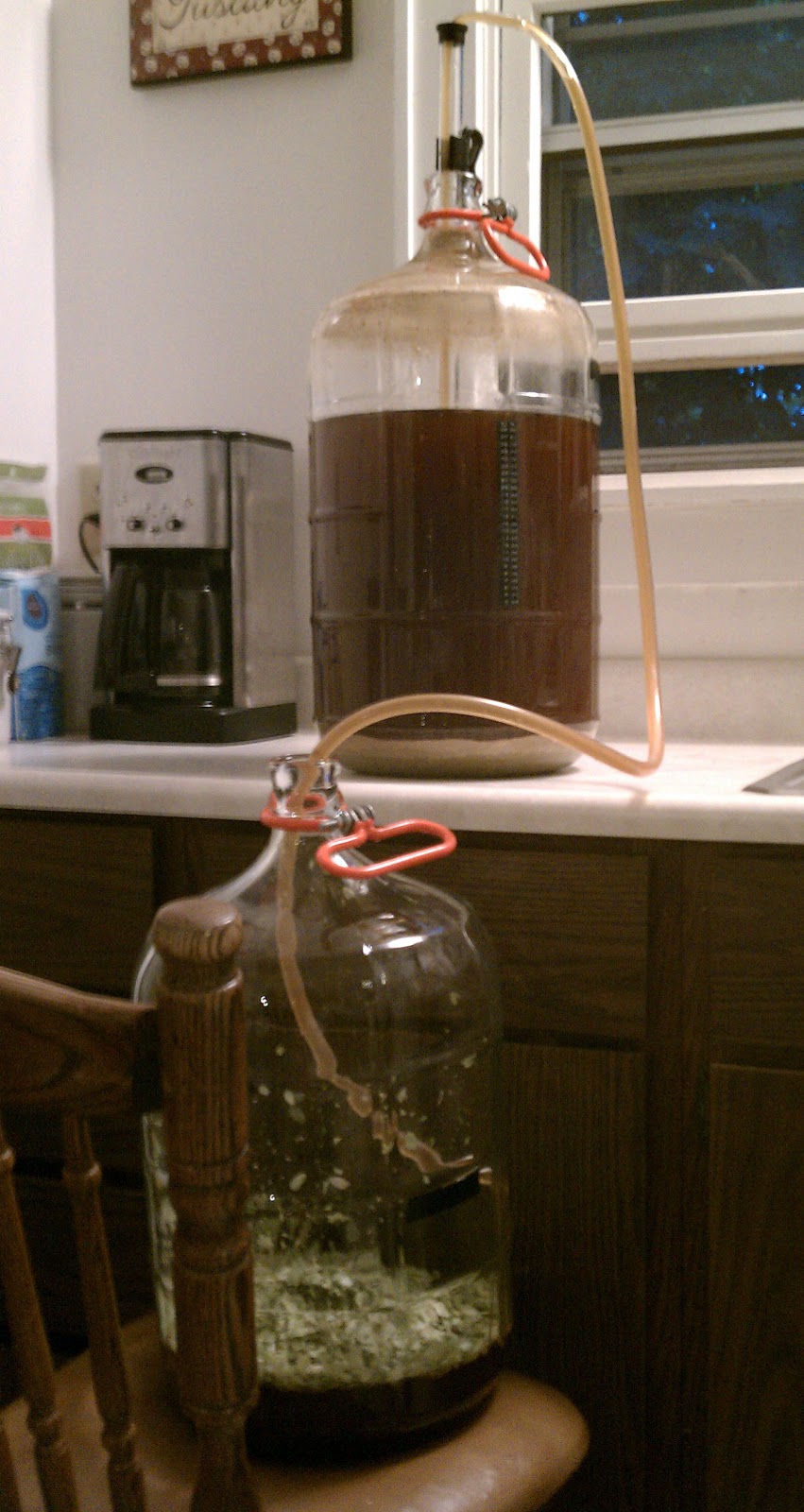
Fermentation is complete. Time to rack to a secondary. The recipe calls for dry hopping 4-6 weeks to add flavor and aroma to the beer (without adding bitterness). This is my first attempt.
Ingredients:
 Smell: Spicy, sweet, Belgian-ish
The best part of racking: Getting a chance to taste the (nearly) finished product. I predict this will be my best beer yet! Great hop flavor. Well balanced. Here's hoping the dry hop adds a touch more spiciness and aroma. Not much more is needed.

Fermentation is complete. Time to rack to a secondary. The recipe calls for dry hopping 4-6 weeks to add flavor and aroma to the beer (without adding bitterness). This is my first attempt.
Ingredients:
- 1 oz Willamette (A: 5.7%) flowers
Observations:
FG: 1.016 (a little higher than the recipe maintains, but close)
Color: Goldenrod yellowish-orange, slightly cloudy
 Smell: Spicy, sweet, Belgian-ish
Taste: Spicy, slight citrus, good hop bite, well-balanced
Experience:
Racking went quickly (for once). Although I opted to use hop flowers, it was a pain to force them into the fermentor through its neck. I may use pellets for future dry hopping. To maintain sanitation, I did my best to crush the hop flowers a bit while still enclosed in their packaging. I used a funnel to get the hops through the neck.
The best part of racking: Getting a chance to taste the (nearly) finished product. I predict this will be my best beer yet! Great hop flavor. Well balanced. Here's hoping the dry hop adds a touch more spiciness and aroma. Not much more is needed.
Friday, May 11, 2012
“Green Eyed" (I)PA
Brew date: April 26, 2012
#7
5 gal.
We begin this batch with my first attempt at a yeast starter the day prior to brewing. I've heard a lot about how much a starter improves the quality of the initial fermentation, and since Kraemer Brew is all about quality (:D) it was really a no-brainer. I read up on the process -- it's quite simple, straight-forward -- but still found this video from Beer Geek Nation a relief, http://youtu.be/jMhFerNTwbQ. Once I had the process down, I simply used Mr.Malty's yeast calculator, http://www.mrmalty.com/calc/calc.html, to give me the precise pitching rate.
Starter Ingredients:
With the yeast starter in place, it was time to tackle my planned IPA. The recipe is adapted from John Palmer's "Victory and Chaos India Pale Ale" published in How to Brew, http://www.howtobrew.com/section4/chapter19-3.html. I did my best to maintain the IBU count, OG, and FG.
Ingredients:


 |
| First yeast starter! |
5 gal.
We begin this batch with my first attempt at a yeast starter the day prior to brewing. I've heard a lot about how much a starter improves the quality of the initial fermentation, and since Kraemer Brew is all about quality (:D) it was really a no-brainer. I read up on the process -- it's quite simple, straight-forward -- but still found this video from Beer Geek Nation a relief, http://youtu.be/jMhFerNTwbQ. Once I had the process down, I simply used Mr.Malty's yeast calculator, http://www.mrmalty.com/calc/calc.html, to give me the precise pitching rate.
Starter Ingredients:
- 109 g DME (light)
- 1 L water
- Wyeast 1099 Whitbread English Ale
Instructions:
 |
| Steeping the crystal malt |
Add DME to water. Boil 10 min. Chill to 75 'F. Agitate wort to aerate. Pitch yeast. Cover with tinfoil. Agitate intermittently. Keep at room temperature.
With the yeast starter in place, it was time to tackle my planned IPA. The recipe is adapted from John Palmer's "Victory and Chaos India Pale Ale" published in How to Brew, http://www.howtobrew.com/section4/chapter19-3.html. I did my best to maintain the IBU count, OG, and FG.
Ingredients:
- 4.083 kg (~9 lb) Pale Ale Liquid Malt Extract
- 280 g (~9 ⅞ oz) Crystal Malt 120L
- 2 oz Galena (A: 13.4%) - 60 min
- 1 oz UK Kent Golding (A: 5.8%) - 15 min
- ⅞ oz UK Fuggles (A: 4.2%) - 15 min
- ¾ oz Cascade (A: 6.4%) - 5 min
- 1 oz Williamette (A: 5.7%) flowers - dry hop
Instructions:
Add grain to 2 gal cold water and steep at 150-160 'F for 30 min. Add LME and Galena hops and boil for 60 min. Add UK Kent Golding and UK Fuggles hops with 15 min left. Add Cascade hops with 5 min left. Strain. Chill wort to 120 'F. Add to fermentor with 2 gal cold water. Top off to 5 gal. Pitch yeast starter at 75 'F.
 |
| My ghetto, post-strain setup to ensure sanitization |
Observations:
OG: 1.056 (1.053 @ 72 'F)
Color: Sunburn yellowish-orange
Smell: Hop
Taste: Sweet, spicy, citrus
Extremely excited for this batch! The flavors are excellent; I love the fine spicyness that I got from the Kent Golding. The bitterness is strong but balanced.
Experience:
The entire brewing process continues to become more comfortable with every batch I add under my belt (and probably to my gut). I can actually manage to put on a record and trust that I can flip it and get back without a boil-over. Speaking of which, the soundtrack for this batch consisted of several albums I picked up from Record Store Day. FYI: The new Black Keys album, "El Camino," frickin' rocks. I must have cranked that one at least three times during the day. Sincerest apologies to my neighbors. I suppose that means this batch should have been a "black" IPA, but that's getting too literal even for a guy that has now named more than a few beers after what he's been listening to. Guilty as charged. So instead, I'm simply going to name this one after my wife's beautiful green eyes -- which were sorely missed during brew day. If that's too sappy for you (and it is pretty fucking sappy) you can chalk the name up to the amazing color of the Willamette whole hops which will be used to dry hop this batch; or, barring that, envy (for this this delicious batch).
The main difficulty -- the source of headache and spills alike -- remains the strain and sparge at the end of boiling. My brew pot is only 3 gallons. (I wish I had a 5-7 gal pot.) We have no other vessel that can hold more than 2 gal. This makes it a huge pain in the ass to strain. In short, I am forced to split the wort between two other pots and bring them both back up to a boil to ensure sanitation. As you can see by the picture, this system is more than a little "ghetto."
Overall, the yeast starter seemed to produce a vigorous fermentation, and the batch now sits dry hopping in a secondary fermentor. I'll post another blog entry to cover that experience. I expect to bottle sometime in early June.


Subscribe to:
Posts (Atom)